
 Bank payments
 Card payments
 Apple Pay / Google Pay
 POS terminals
 Buy Now, Pay Later
 Shipping+ and Shipping+ Pro
 Click to pay
 Refunds
 Recurring payments
 Payment link
 Donations
 Kniks gift card
 Merchant financing
 Payments for accommodation businesses
 Payments for service businesses
How to get your online store recommended by AI
Ask ChatGPT where to buy hiking boots for wide feet, and you won’t get a page with ten blue links. You’ll get a few stores, a reason to buy from each, and maybe a recommendation based on what you’ve told it.
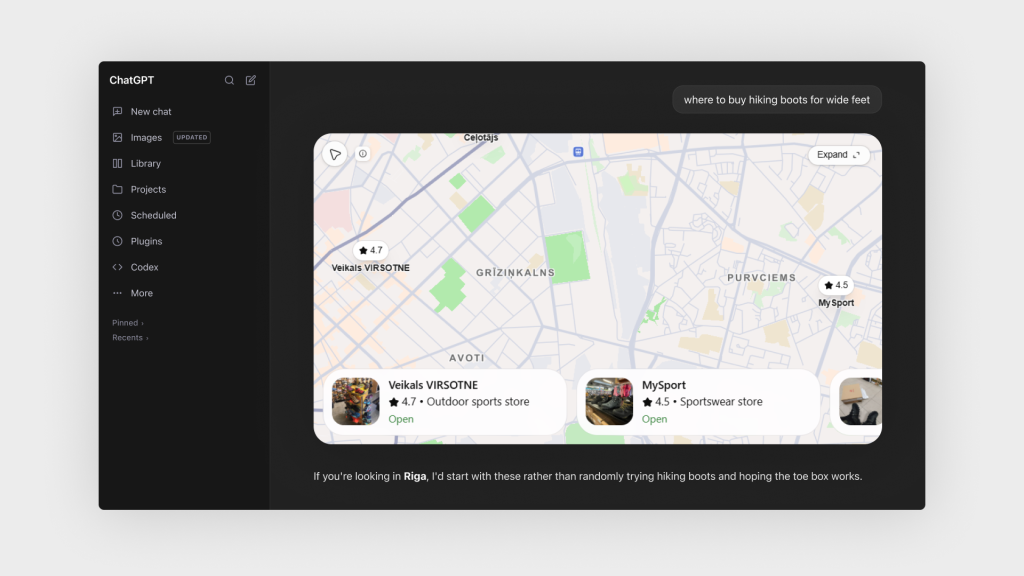
ChatGPT search results for wide-foot hiking boots in Riga
That’s great when you’re shopping. It’s a different story when you run the store. Google gives you a chance to compete for the click. With ChatGPT, Gemini, and other AI assistants, your store may not even make the shortlist.
And shoppers are already using these tools to find products. AI traffic to retail sites grew 393% year over year in the first quarter of 2026, and those visitors converted 42% better than traffic from paid search, email, and affiliates.
Here’s where it gets interesting: Being a smaller brand doesn’t put you at a disadvantage. Similarweb’s 2026 Brand Visibility Index found that brand size alone does not predict AI visibility.
A smaller store with better product information can still get picked over a much bigger competitor. So what makes an AI assistant choose one store over another?
How an AI assistant decides who to recommend
Google gives you a list of pages. An AI assistant has to put together an answer. That means it can pull information from several places before deciding which stores to mention. In fact, around 77% of the URLs that AI engines cite sit outside Google’s organic top 10.
Page one still matters for SEO, but it’s no longer the whole story. The difference is easier to see when you put traditional search and AI answers side by side:
| Classic search | AI answers |
| Wins by ranking above competitors | Wins by being easy to quote |
| One page targets one keyword | One page answers a question, including the follow-ups |
| Shopper compares options themselves | Assistant compares, then names a winner |
| Traffic is the measure | Being named is the measure; traffic follows |
There’s another important difference between the two: timing. Magebit, an expert in organic growth, finds that the two move at different speeds. Technical fixes can be picked up by Google within weeks, while building visibility in AI answers takes longer.
So where should you start? Here are six questions to answer first if you want your store to show up in AI recommendations.
1. Can AI read my store?
Before you worry about getting recommended, make sure AI can see your store. Ask your developer or agency to check two things:
- Does your robots.txt block AI crawlers? Some stores blocked them in early years to keep their content out of AI training data. But training crawlers and crawlers used to fetch pages for live answers are not always the same, so you can block one without necessarily blocking the other.
- Is your product information on the page? If the price, stock, or description only appears after JavaScript loads, some AI tools may not see it. This is more common with headless stores and sites that rely heavily on apps.
If AI can’t access the page or see the information on it, nothing else you do for answer engine optimization (AEO) will matter.
2. Does my content answer real questions?
Shoppers ask assistants whole questions:
- What is the difference between a softshell and a hardshell?
- Which coffee grinder is quiet enough for a flat?
- Where can I get spare parts for a ten-year-old dishwasher in Latvia?
A store that has published a straight answer to one of those gets pulled into the response. A store with a category page and nothing else gets skipped.
These are the formats that earn citations:
▪️ One page per real question, with the answer in the opening two or three sentences
▪️ Comparisons between products you actually stock, since “Model A vs Model B” is among the most quoted formats there is
▪️ Buying guides carrying real specifics: sizes, materials, compatibility, who it suits and who it does not
▪️An honest FAQ on delivery, returns and warranty, written as sentences rather than a wall of terms
Pro tip: write the opening paragraph of every page so it survives on its own. If someone lifted only that paragraph, would it still be accurate and useful? That paragraph is the one that gets quoted.
3. Does AI have enough product information?
AI needs enough information to understand what you sell. For every product, make sure the key details are complete and consistent everywhere they appear, including your Google Shopping feed:
- Brand, model, and the product name people use
- Size, weight, material, colour, compatibility
- Price, currency, and whether VAT is included
- Real stock status
- Delivery time and delivery options
- Return window
Keep the information consistent, too. If the product page says three days but checkout says five, the assistant has conflicting information to work with. It may choose the source it trusts most or skip the store altogether.
For Baltic stores, delivery details are especially useful. “Delivered to Omniva, DPD and Venipak parcel machines across Latvia, Estonia and Lithuania in 1–2 working days” tells an assistant exactly what it needs to know. “Fast delivery across the Baltics” doesn’t.
Take Ambler Surgical as an example. They sell 20,000+ surgical instruments, most separated only by small technical differences, which made the catalog hard for machines to read.
Once the product details were cleaned up and better organized, they reached first position in AI answers, with traffic from ChatGPT growing 872% in a year.
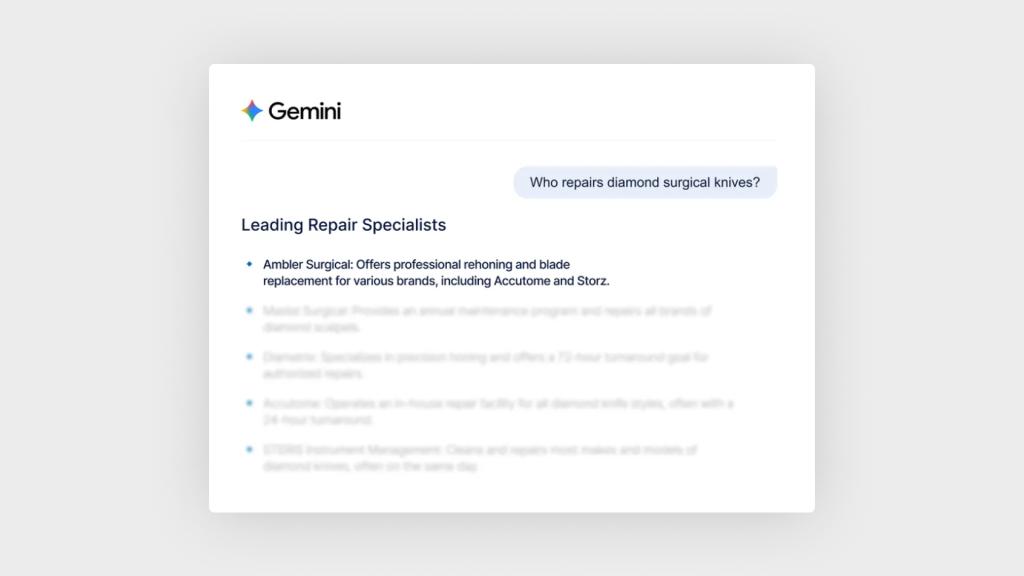
Gemini AI recommending Ambler Surgical for diamond surgical knife repairs
4. Do other sites back up what I say?
Most merchants stall here, which is also where the biggest gains sit. Your own website can tell an assistant what you sell. Other websites help confirm that it’s true.
Look at the places your customers already use: review sites, marketplaces, forums, local media, supplier pages, and industry directories. Make sure your store is described accurately and consistently across them.
You can also contribute to relevant communities or write guest articles on sites that your audience reads. The important part is that these should be genuine mentions, not a pile of links created just for SEO.
A simple rule: if you want an assistant to say something about your store, make sure other people are saying it too.
5. Does the shopping experience match what AI tells people?
Visitors who come from an AI assistant have already done some of the research. If the assistant says you offer free returns and local payment options, they expect to find exactly that when they reach your store.
If they hit an unexpected fee, can’t find the payment method they were promised, or have to create an account before checking out, you can lose the sale.
So keep the basics clear: familiar payment methods, no surprise costs, guest checkout, and delivery options that match what you advertise on the product page.
6. Am I actually getting recommended?
You don’t need a new tool to start. Just check whether your store is showing up when customers ask AI what to buy.
- Test the questions yourself. Once a month, ask ChatGPT, Gemini, or Copilot the questions your customers would ask before buying. Note which stores come up and whether yours is one of them.
- Check your analytics. Look for visits coming from AI assistants. The numbers won’t be perfect because some AI traffic gets counted as direct traffic.
- Look at sales, not just visits. A smaller number of visitors can still matter if they are arriving after doing most of their research and are more likely to buy.
Where not to waste your effort
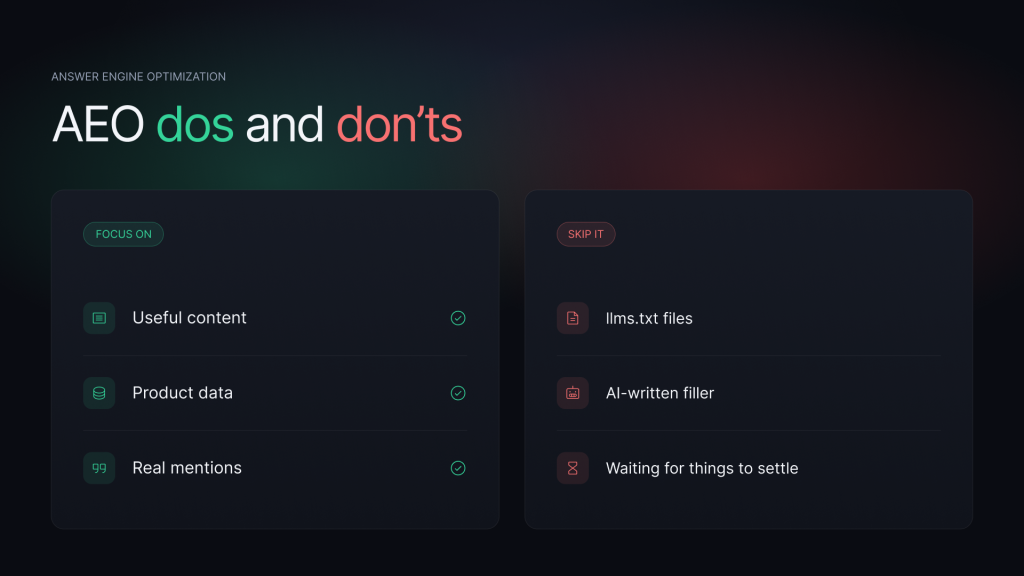
AEO dos and don’ts for ecommerce AI search optimization
Not everything being discussed in AI search is worth your time.
- llms.txt files. They’re easy enough to add, but the results so far are weak. Ahrefs found that 97% of llms.txt files received no traffic in May 2026. Add one if it’s useful for your setup, but don’t build your AI strategy around it.
- Content written for AI instead of people. Adding thin and generic answers won’t help. Write useful content that answers the question properly.
- Waiting for things to settle. AI search is still changing, but there’s no need to wait for it to figure itself out. Start with the basics now, see what gets your store mentioned, and improve from there.
Final thoughts
You don’t need to rebuild your store for AI. Start with the things a shopper would need to know before choosing you: what you sell, how much it costs, when it will arrive, what happens if they change their mind, and why they should trust you.
Make that information easy for AI assistants to find and understand, and keep it consistent wherever your store appears. Then ask the same questions your customers ask and see which stores get recommended. If yours isn’t one of them, you’ve got a clear list of things to work on.
Related Magebit resources:
Why E-commerce Brands Need to Prioritize Answer Engine Optimization (AEO) in 2026
Local SEO for E-commerce: How to Rank Your Stores for Local Searches in 2026
UCP Checklist for Magento/Adobe Commerce
Magebit is a full-service e-commerce agency built around complex work: enterprise replatforming, deep ERP and PIM integrations, complex SEO, and B2B commerce for mid-market and Fortune 500 merchants. Founded in Riga in 2013 and now working across three continents, Magebit is ranked the #1 Adobe Commerce partner in Adobe’s Partner Finder, holds more Hyvä certifications than any agency in the world, and is a Shopify Plus partner.